THE KNIGHTS OF BENEVOLENCE
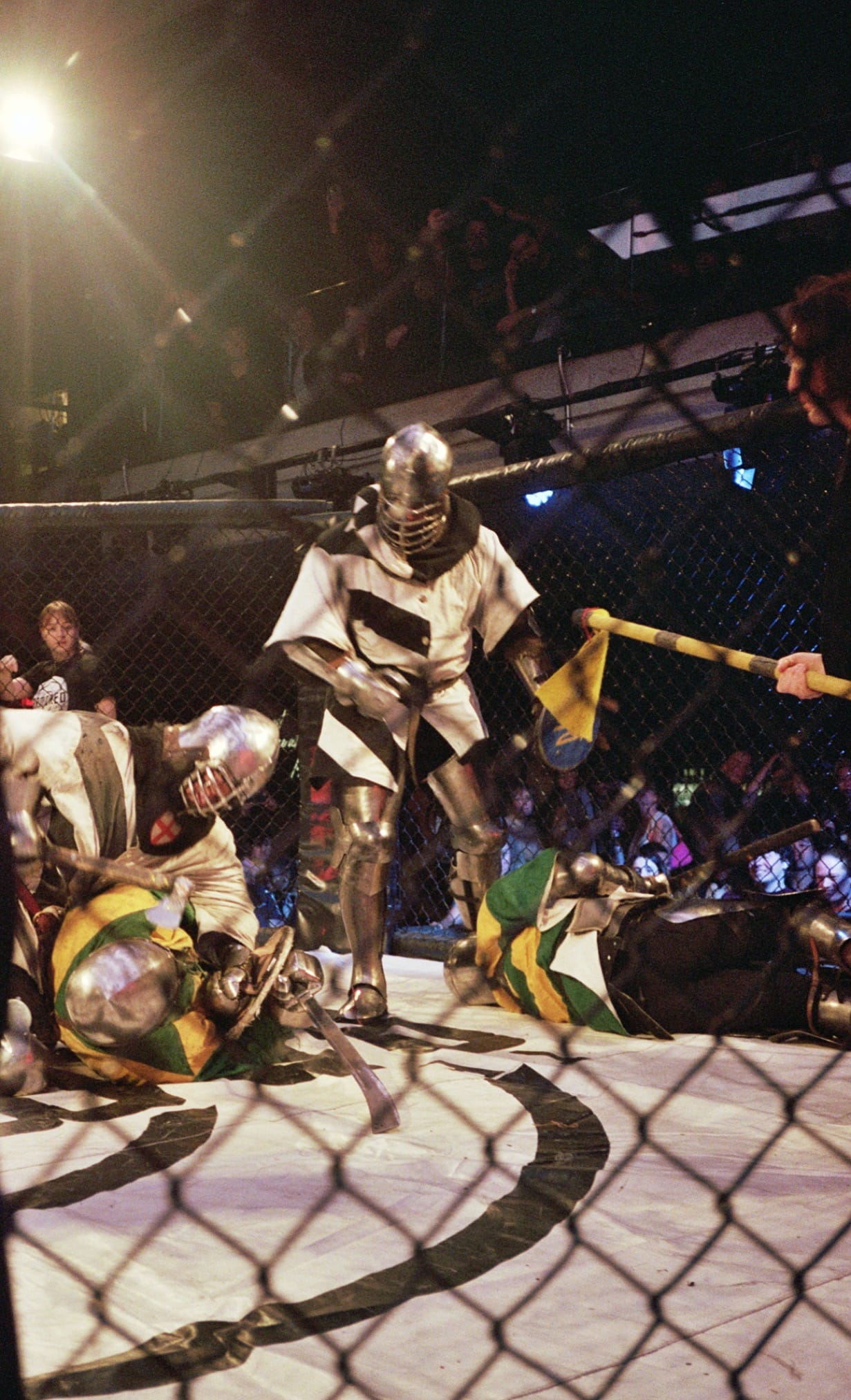
Ringside at 2026's first Armored League cage fight.
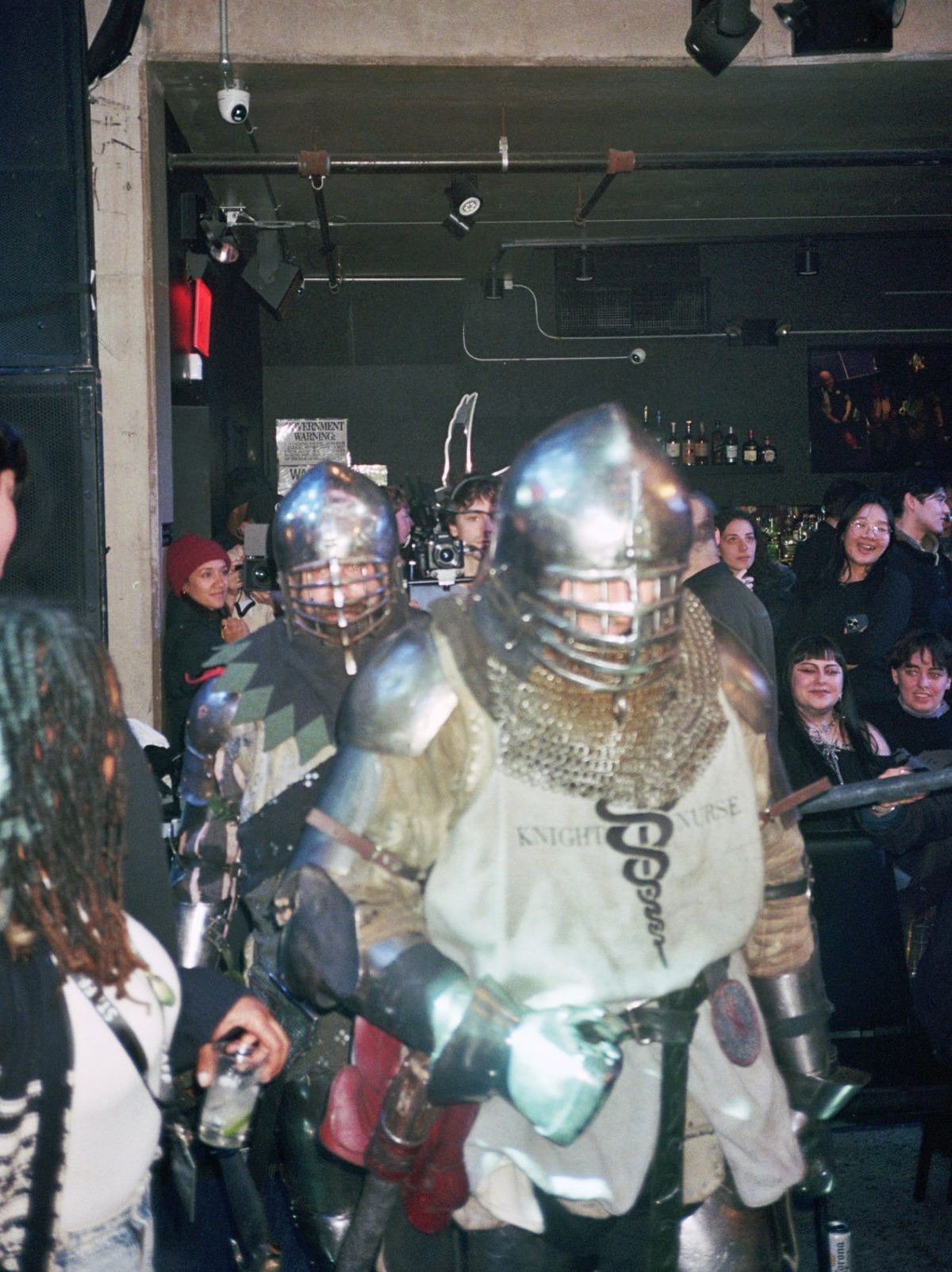
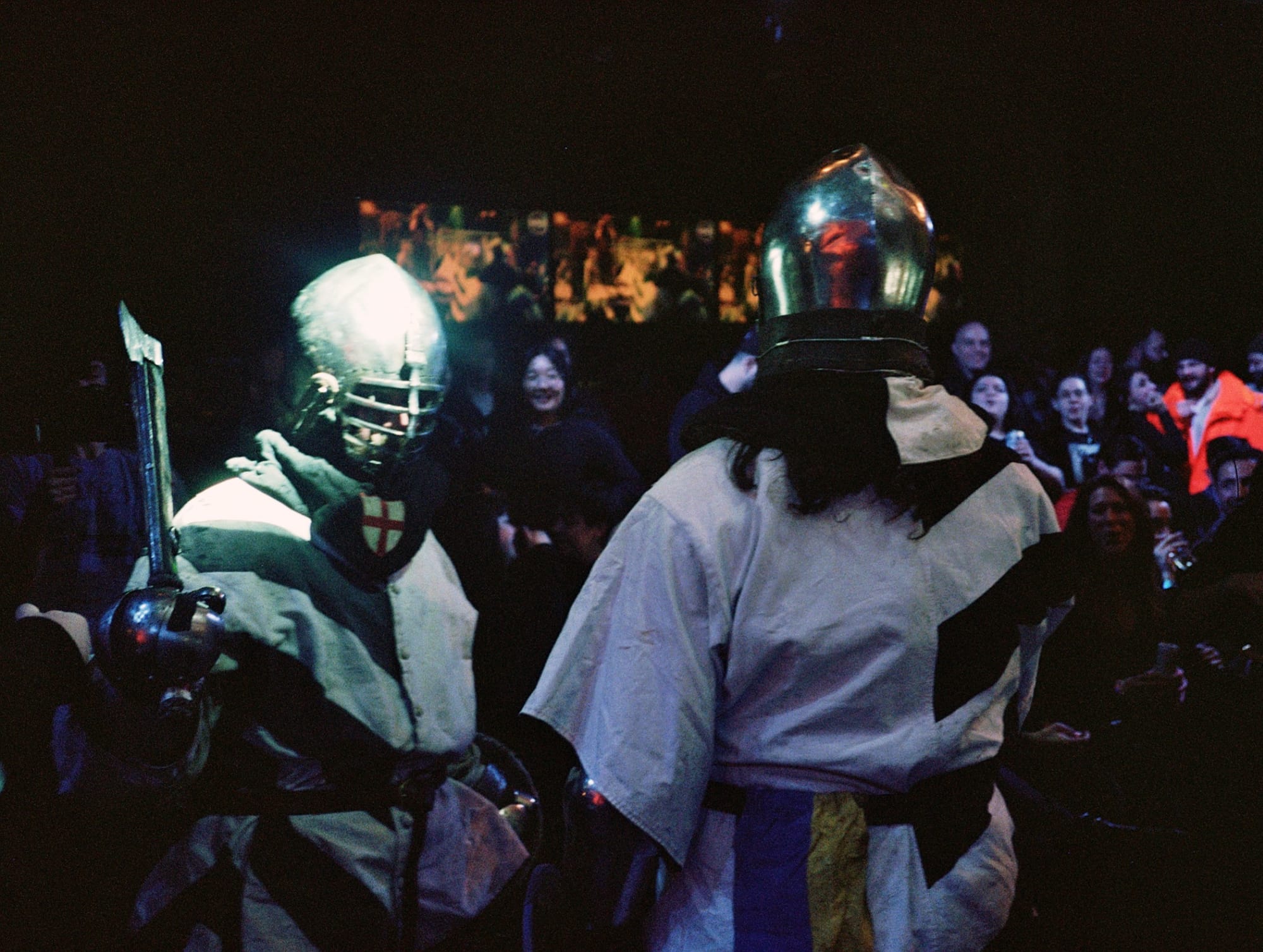
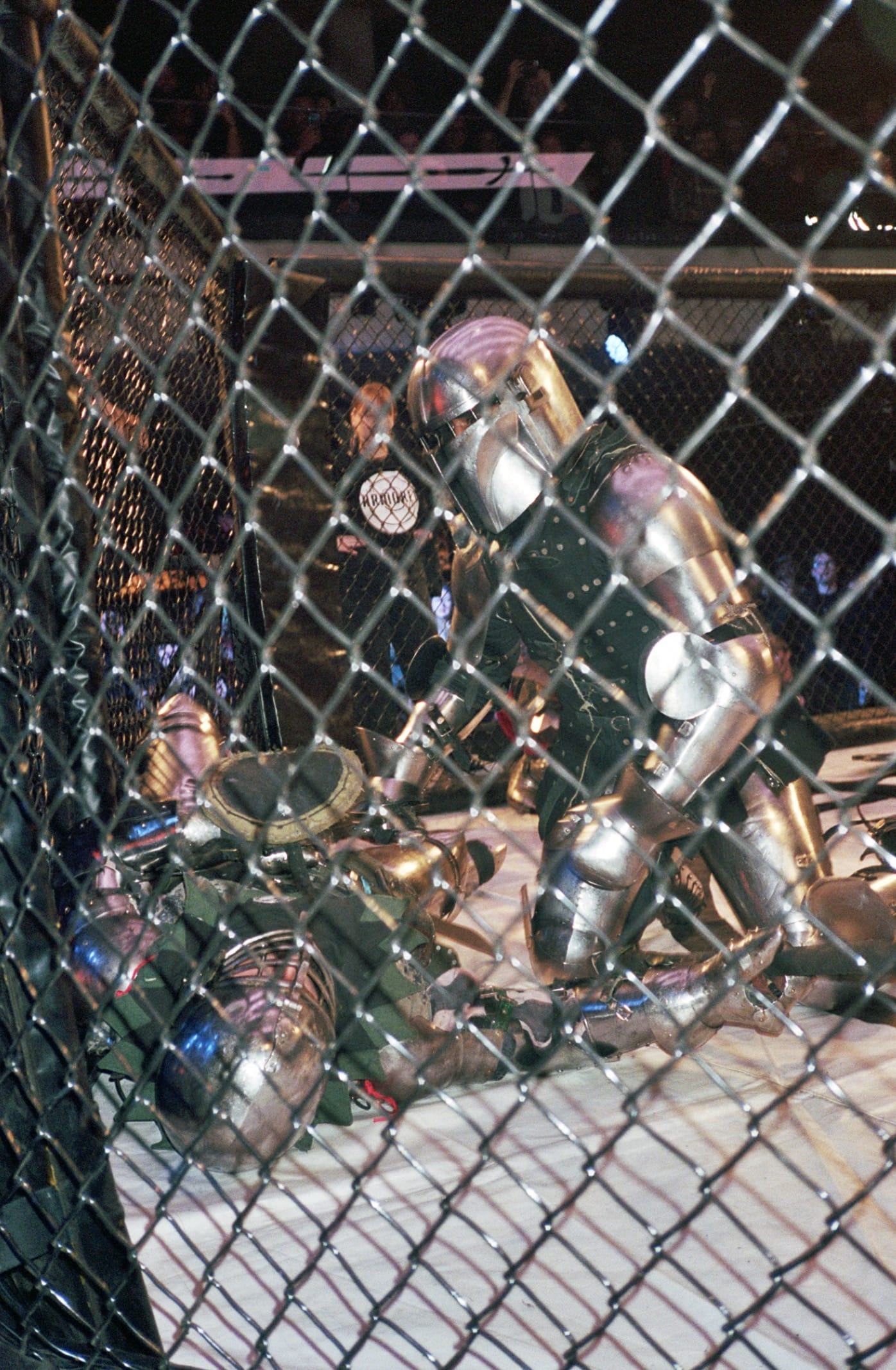
January 29th, 2026. Queens, New York. The Armored League and Gladiators NYC have arranged a hexagonal MMA cage flanked by rows of seats on each side. People spill into walkways and hang over the rails on the second floor. It’s a sold-out house: packed and unruly. A giant wave pool of bodies inside Melrose Ballroom. The room is saturated in an intense technicolor veil.
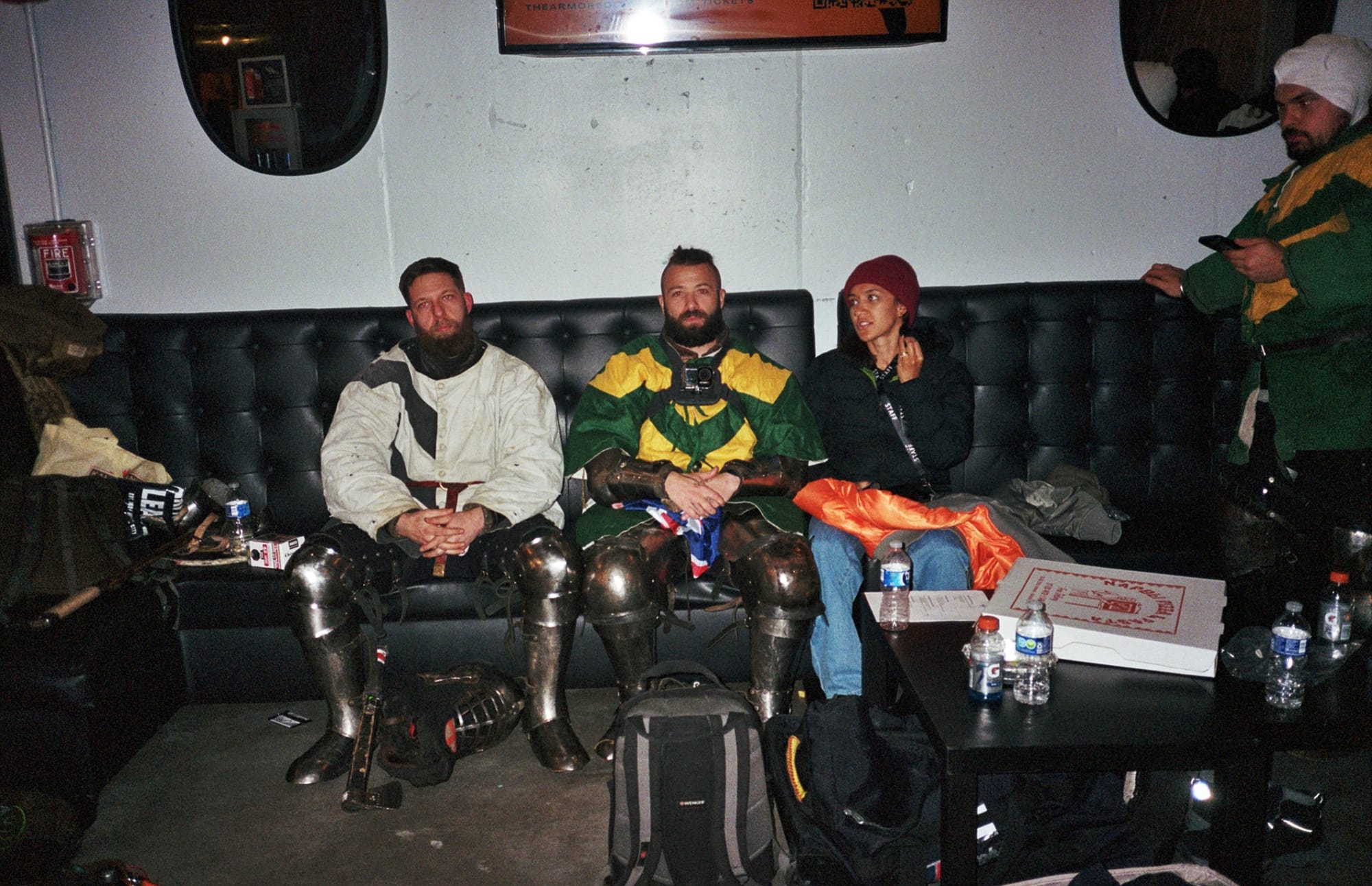
Upstairs, the fighters step into complex labyrinths of armor and begin to warm up—thoughtfully and with great ceremony. Suddenly, I am witnessing the late medieval ritual of knights preparing for battle. A gentleman in red kneels to the floor while someone fusses over his armor, the Scorpius constellation stitched onto his tunic. How bewitchingly akin to The Accolade, painted by Edmund Blair Leighton in 1901, that appears over and over again on my TikTok feed, in edits and moodboards…
Fighter Kora Wyr (United States)—who is working the event tonight, but slated to compete just a few weeks from now—and Shan Lind (who referees and volunteers their time as an instructor in addition to battling in the League) are happy with the recent uptick in interest around medieval culture and aesthetics and the tight-knit communities that surround them. Bohumil Masničák (England) notes that in a couple of decades, armored fighting “grew from a niche sport to a global phenomenon.”
Says Lind: “I used to own a gym in Texas in 2020. You’d be very surprised by how quickly people get into this. By the time I moved here in 2024, our gym was a moneymaking entity, purely off subscription services where people would come to the gym and rent the armor, wear the stuff, get trained, go to competitions. I don’t think we could have done that in 2008.”
They also note that an increase in armories around the globe—expanding from Eastern Europe and into India, Mexico, even the United States—have made “cool” gear more accessible and affordable. Style and artistry are certainly primary concerns of the league, whose executive producer, Pedro Martin, tells me, “This is a time machine. But we are remixing everything and seeing what works.” All the elements of the evening—swords projected onto the ceiling and the announcer Morgan Cole’s impeccable tuxedo—are fine-tuned.
Fighter Abeid “Mando” Mitchell (United States) walks photographer Swoope and I through the weaponry. His movements are effortless and elegant. He draws figure eights through the air with a mace. It’s a sorcery you only really see in film. I am trying to identify which weapons are closest to my arms of choice in my current Elder Scrolls playthroughs.[1]
The perennial re-emergence of passion for the medieval isn’t a new phenomenon, but it is certainly taking place during a particularly egregious time in America, during which widespread intolerance for the presence of a global community is fed by general ignorance and blind support for a fascist regime and paired with a deeply us v. them mentality. Each decade since Victorian times contains a unique flavor of generally European-centric medieval flare: the prominent midcentury medieval of the 1960s and '70s, the dark velvet goth elegance of '90s medieval, or the recent cozy cottagecore (and cozy gaming) of the 2010s, increasingly fostered by spaces online.
In her video essay “Why the Medieval Aesthetic Never Dies,” Kaz Rowe notes how “our modern reinterpretations of medieval aesthetics, therefore, are not a direct channeling of the Middle Ages, but instead the product of an interpretation of an interpretation of an interpretation of an interpretation.”[2] Although the ruling classes of proper medieval times were draped in metal adornments, they might be surprised at the removal of chainmaille’s utilitarian purposes by the frivolous chainmaillers of today who weave heavy, ornate stainless steel jewelry (this author is one, herself).
So, what more? Humanity is always embracing style and swagger over and over and over again. So many gorgeous suits of armor in the early 1500s took cues from fashion as much as from the battlefield. But there is something even more widespread driving the increased popularity of armored combat.
-
Skyrim comradery online confirms that one must stop repeatedly defaulting to a stealth archer build.
-
Kaz Rowe, “Why the Medieval Aesthetic Never Dies: The History of Medieval Revival Fashion,” YouTube, April 27, 34 min., 57 sec., 2023, https://www.youtube.com/watch?v=-EVWQGzxEwU.
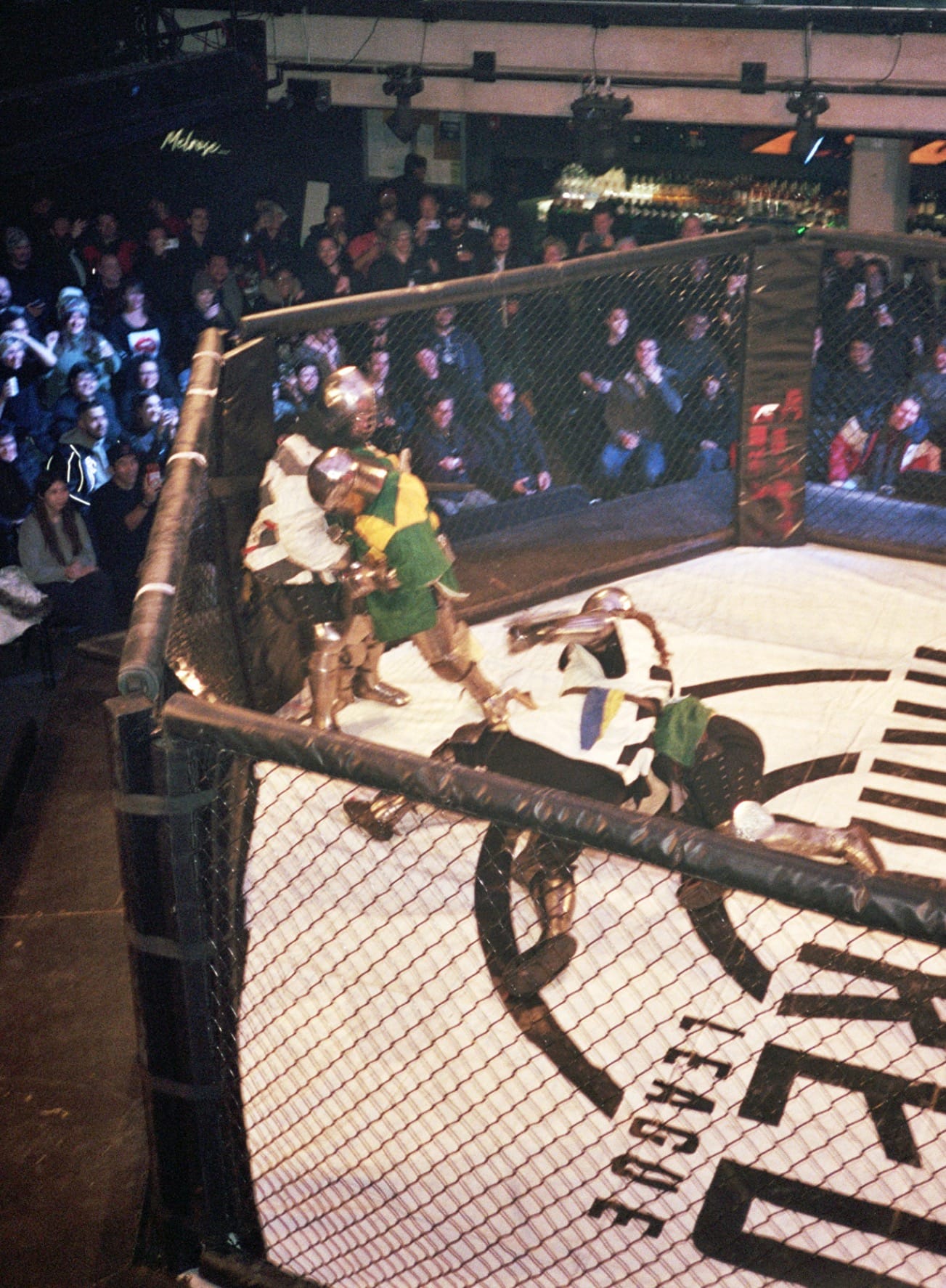
The people performing tonight possess all the gear that bewitches our contemporary collective imagination, and they inhabit their roles as both athletes and performers with distinguished command. In other words, they’re extremely cool. Longswords wink like cats’ eyes in the arena. Gauntlets and heels land shaking blows on helms. The sound of weapon to armor rises above the cheering crowd. Shields become weapons of the offense, digging between faulds. It’s as violent as combat sport can be but bolstered by this greater, universal spirit. It’s intoxicating. Tonight there are no undercurrents of genuine animosity between the players (Glaive’s CJ Somavia wagers that some of the events abroad might have a more intense nationalistic competitiveness).
My friend and fellow writer Nick Greer and I have discussed this realm of medieval aesthetics at length. He says we are deep in what he calls the neofeudal turn and writes:
“As the American empire declines and the world hurtles later into capitalism—a process accelerated by the expansion of technology and policy decisions like corporate bailouts and low interests rates that transfer wealth upwards—underclasses find themselves laboring under increasingly precarious conditions to afford a diminishing quality of life, which we can only ever rent. This backslide, combined with an inability to wrap our heads around the systems producing this change, have inspired us to reach for a familiar narrative framework that rhymes with our current moment: the Medieval.”
So perhaps spawns the yearning for fantastical thinking, for imagining an escape. Somewhere a kingdom is clearly defined; somewhere the notion of powerlessness might even become poetry, or strained through a lens of the romantic. For, Greer writes, the neofeudal turn is “capturing the tragic absurdity of the economic horror we live in.”
The mid 2020s has positioned us in a deep, reflective phase of medieval appreciation, with dark fantasy and knightcore folding the internet into a twilight, metallic embrace. Some widespread acknowledgment of Dungeons & Dragons might be triggered by mainstream media like Stranger Things but it is sustained by a stronger shadow being cast over the collective imagination. Deeper into the belly of capitalism we go, further from the light we march, burying final shreds of belief in governmental systems and in the function of the corporation and the ruling class. Eat the rich! The Armored League’s fighters feel like an embodied expression of these intense, all-consuming emotions.
Says Wyr: “Beyond all of your context. Take off all of the masks. Who are you?
Their armor is as close to the source as one might get. I ask Wyr how authentic she finds their gear and she tells me they “try to keep it as historically accurate as possible while acknowledging safety.” I happened to visit the Worcester Art Museum in Massachusetts the week after the fight, whose archive of armor and arms has just been given a permanent home as of November 2025. The collection is the most extensive in America, gathered by the industrialist John Woodman Higgins, the president of Worcester Pressed Steel in the first half of the twentieth century. The exhibition catalogue, authored by Jeffrey L. Forgeng, notes that during the late Medieval period, “A full suit of armor might weigh on the order of 50 lb. (23 kg), much less than modern soldiers carry in the fields today, and it allowed almost full range of motion.”[3] So according to Forgeng’s research, the armor worn in the League is as heavy as its blueprint, if not up to thirty pounds heavier (Lind and Wyr indicate that this likely relates to modern safety precautions). It amuses me to think that our contemporary fighters have a larger burden to carry than their predecessors.
And despite this, they move with cutting precision. And they’re fast. Watching armored people walk around in videos on my iPhone hasn’t even slightly prepared me for the casual nature of the fighter’s gaits as they approach the cage.
I’ve seen ren faire-style jousting and been to one of the restaurants in the Medieval Times chain—which include scripted performances and are delightfully soaked in fanfare and pageantry—but, as Jake Coles (England) tells me, “This is close to the real deal. You have to look after each other or you’re going to get hurt.” The comradery is a big part of what goes on both during practice and in the cage, and is one of the largest factors in Coles’s own relationship to his artistry. There is the innate respect from one athlete to another in such a niche community, where the struggles and intricacies of battle are not perceived or considered by the rest of the world, in the way they might be with an internationally-celebrated sport like American football.
- Jeffrey L. Forgeng, Arms and Armor at the Worcester Art Museum (Worcester Art Museum: 2025), 15.
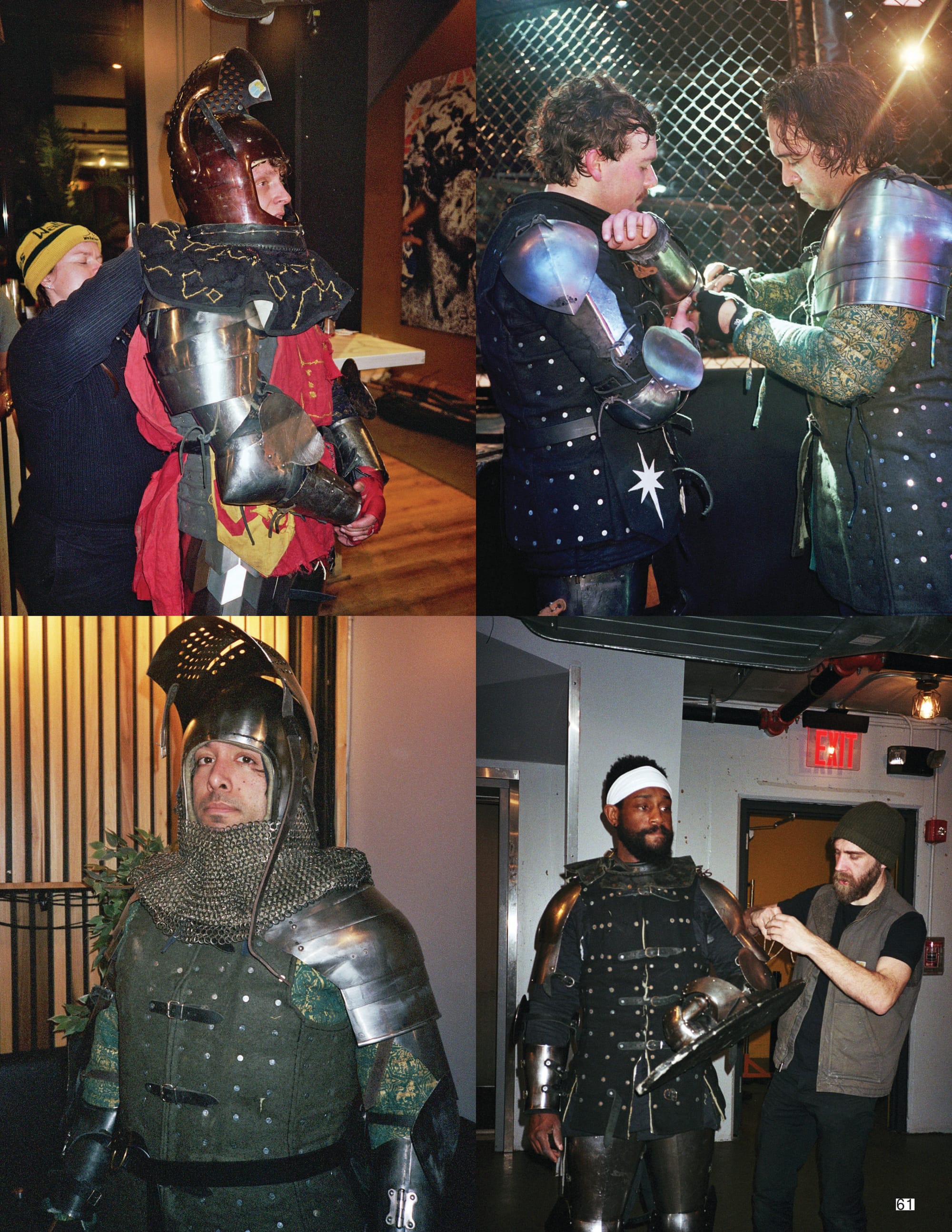
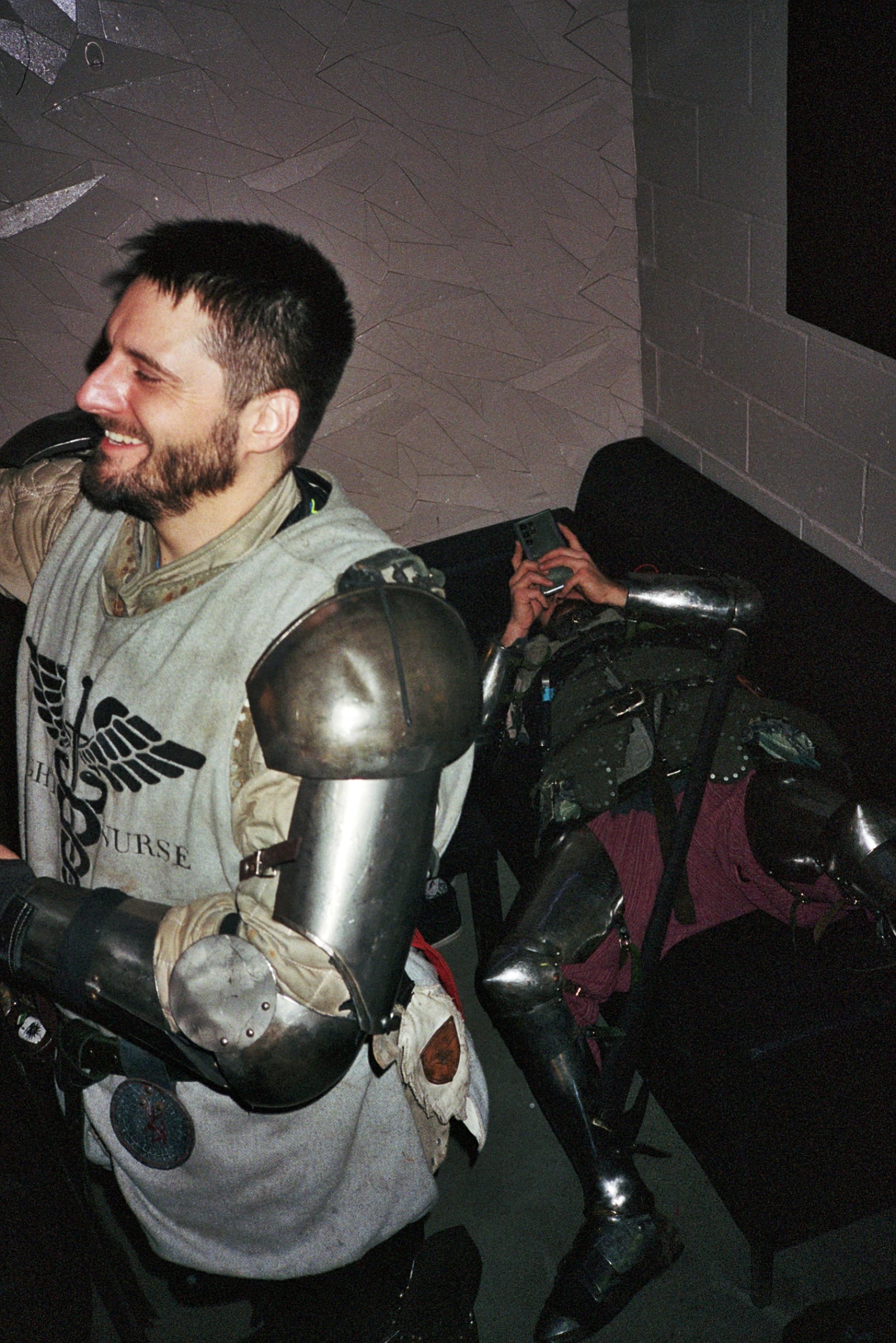
Samuel Wride (Australia) describes armored fighting as “a whole new genre of violence…There’s no other sport in the world where you can swing real weapons at people and then take your helmet off and hug them at the end.” There is this surprising tenderness to the way the battlers describe themselves, which conveniently lends itself to all the existing notions about chivalry and knighthood and honor.
The audience, on the other hand, is composed of intense thrill-seekers and plenty of beer.[4] The Armored League knows this, of course, and curates a seamless vibe by interlacing Metallica with Gesaffelstein and Skyrim’s main theme.
I’m speaking with some of the audience upstairs. Trying to figure out the vibe. John F. is stationed with a group of friends. “We’re into MMA. We’re into video games and Dark Souls types of stuff.” There does seem to be a significant crossover between the MMA community and armored fighting. Perhaps there are also similarities to boxing. The central “ring,” of course. And the psychological intimacy of the sport. The isolation of the stage. And the Armored League has a similarly clear point system, there are numerous ways to win a fight, and there are regulations for the weight of weapons and number of weapons allowed at a time on one’s person.[5] Beyond that, it’s hard for an unpracticed person to conceive of swinging a four-pound weapon or armored fist at someone else for sport.
I end up speaking at-length with Masničák after the event, and he says something which feels quite apt about one’s impulse to take up the lifestyle: “You have to be close to being a bit of a psychopath.” Indeed, I think to myself. But tethered to the absurdity of pursuing violent sport, there’s this enigmatic intensity and sweetness to the emotions that fighters exhibit. Part of it is certainly due to the aforementioned camaraderie of niche interest. But another part of it, perhaps the more obvious part, indicates that we are drawn to spectacle and violence and all that feels arcane. That medieval-style armored fighting just happens to be tapping into our collective yearning in numerous ways at once. We have been seeking community outside the internet since its inception. We keep telling ourselves this; every think piece outlines it one way or another. But the community in sports in America is currently—and has in one way or another always been—so deeply entrenched in the violent insertion of the ruling class and celebrity and its financial defense. Perhaps it is the fate of anything, once it gains enough traction here. Jake Paul vs. Mike Tyson, Andrew Tate v. Chase DeMoor. Publicity stunts. The NFL pacifies public unrest by beguiling us with an emotionally moving and politically relevant halftime show, adapted so closely to our current conversations, buffered by imperialist commercials and AI slop and things that, really, no one wants to see.
Here, at The Armored League, a vigorous undercurrent of self-determination and community sustains the work and those involved.
I follow up with Masničák to get a better sense of his feelings about how this combat configures into the world as it is today, especially given that he travels the world to participate in his artistry:
“I think violence is deeply rooted in a human's DNA, so if you are not involved in it, you are starving yourself. Modern society—even with the ongoing wars across the world—lives relatively peacefully so you are denying yourself a basic instinct.
Humans are a social species, so to be part of a group is primal behaviour. To bring violence and the social aspect together provides a controlled environment to very raw instincts which very few sports can provide.”
I’m thinking about this framing of violence, which lies outside of the context of and need for resulting harm and inside the context of the “group.” I’m fascinated. Some act of violence as an expression, as the body’s brushstroke. These gritty elements of armored combat offer cool shadows away from commercial sports’ status quo of yelling at the TV.
- For the combatants, the element of beer only comes into play after the fighting, but that it is indeed central to the culture, as it has always been, as it will always be, etc.
- The preparation sounds intense, and it seems that most of the fighters’ training takes place with Gladiators, which generally feeds into the league.
All photos by Lanell Swoope
As the night comes to a wrap, England takes the victory, and all the knights in glimmering armor step out of their shells. Quite a bejeweled departure from the ordinary. Outside, we are having one of the coldest winters in recent memory in New York, and with the cold comes a bitter quiet on the streets. Loud winds, urban snowdrift, piles of snow imbued with exhaust.
There’s a meme perennially circulating about “explaining things to a Victorian child” or, more appropriately, “explaining things to a medieval peasant” as a way to cope with the inconceivable technological and social changes that have occurred in the twentieth and twenty-first centuries. This feeling that it’s all just too out of control, that we will never be free. In a discussion with writer and publisher Chris Molnar, he describes how “this sense of timeless combines simplicity with mystery. It's an instantly legible aesthetic language that's ultimately unknowable, so year after year there's a hunger for more.”
I’d wager to say that if you had the opportunity to will anyone into existence from across time, they’d understand the appeal of the community that The Armored League is presenting. There’d be an unspoken bond. One that recognizes how our gaze might settle on a spectacle so dazzling. Ancient tales of reverential drama and glory unfolding in real time, the illuminated pages of a fairytale brought to life.