
THE DEATH OF THE LAN PARTY
An obituary on LAN parties and where they've left us today, by Merritt K.
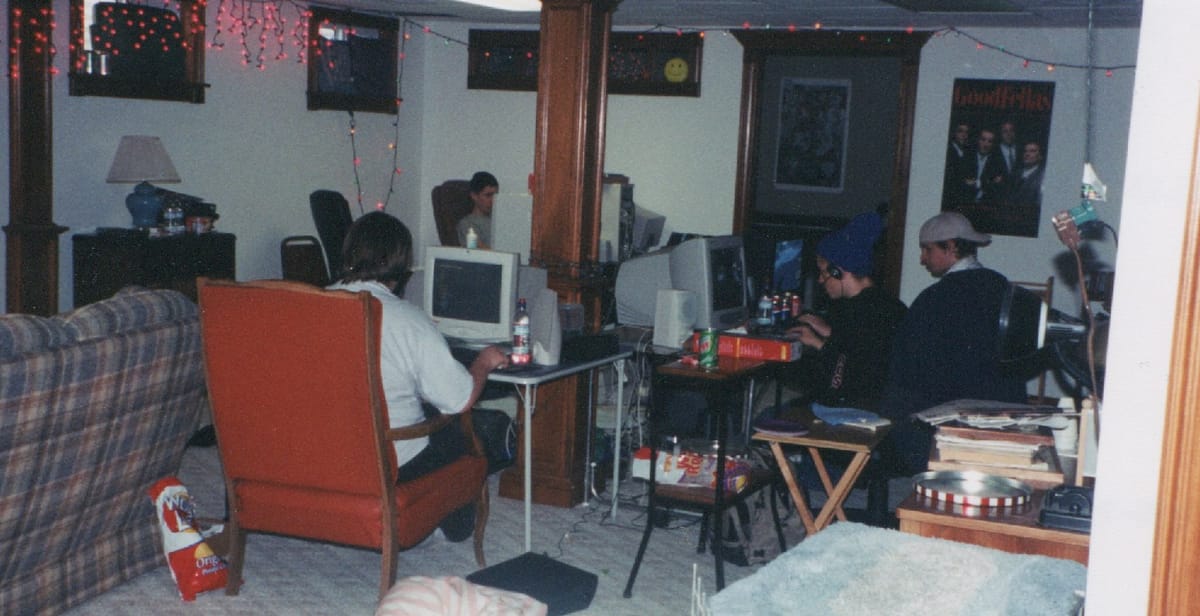
Hiroshi Yamauchi, President of Nintendo from 1949 to 2001, was once quoted as saying that the PlayStation outsold the Nintendo 64 in Japan because Japanese gamers like "to be alone in their rooms and play depressing games." Today, more gamers than ever are playing games by themselves in their rooms, but they aren't exactly alone. They're playing with friends and strangers around the world over the internet, competing and cooperating with other players in games like Fortnite, Call of Duty, Minecraft, Roblox, and more.
But even as gaming has become more connected, it has become paradoxically less social. Multiplayer games, which used to require the physical presence of the players in the same location, are now predominantly played over a network connection, often with teammates and enemies who are complete strangers. "Couch co-op" games have become a sort of boutique experience, and the split-screen first-person combat that was popularized by games like Goldeneye and Halo is a thing of the past. Yet only a couple of decades ago, the face of multiplayer gaming was not someone sitting alone in a room and speaking into a microphone. It was sweaty, chaotic, and eminently social — the LAN party.
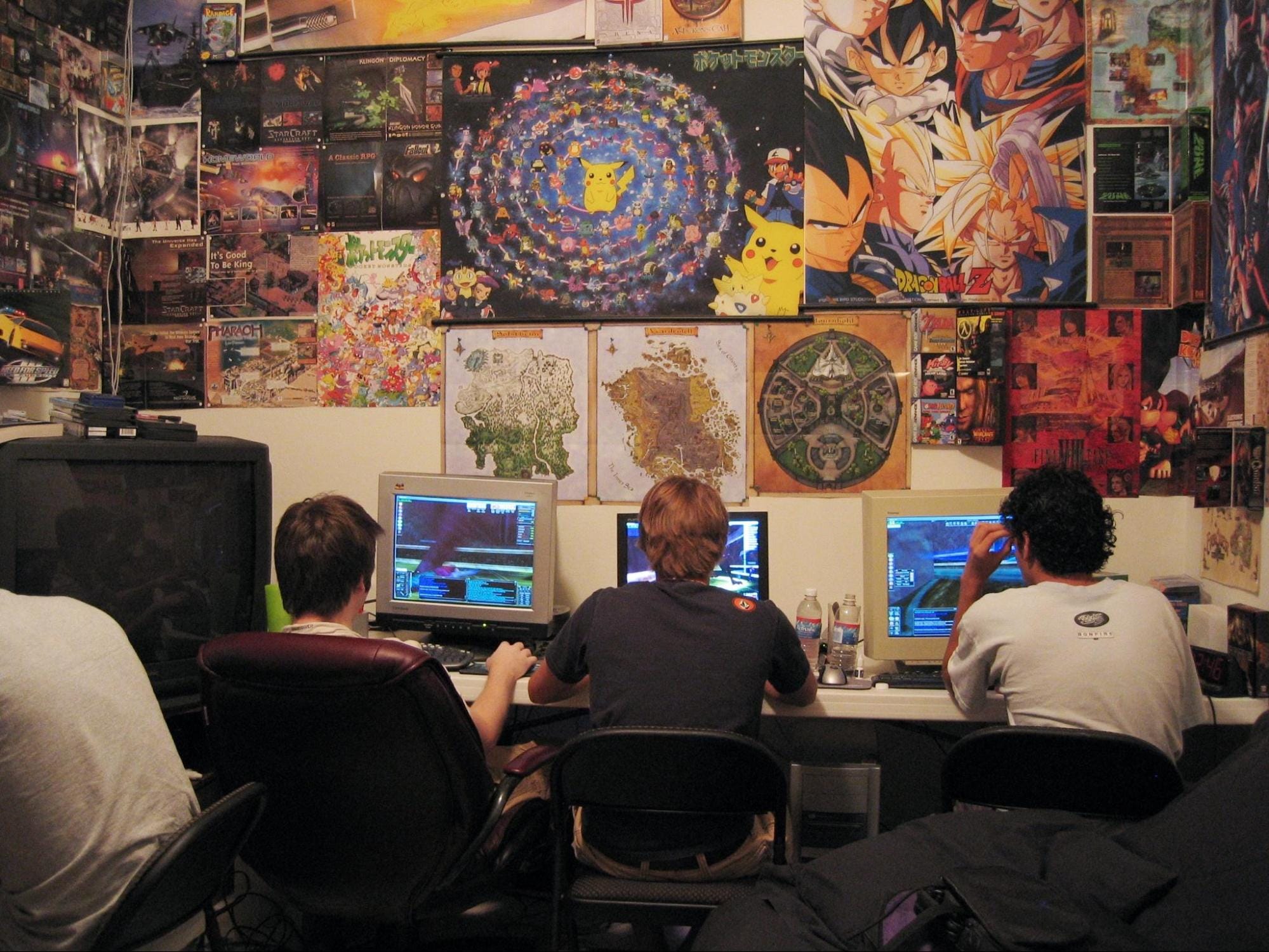
WHAT WAS A LAN PARTY?
LAN parties flourished in the 90s and 2000s, when genres like real-time strategy and the FPS were ascendant on personal computers. Unlike older multiplayer computer games, which were often turn-based, these genres demanded low-latency connections in order to communicate the rapidly-changing positions of characters and objects in the game world between players. However, even as game developers were taking advantage of increases in graphical and processing power to create new experiences, communications infrastructure lagged behind. When Pew Research began tracking internet usage in the United States in the year 2000, only 1% of households had a broadband connection. Thus, the easiest way to reliably play real-time multiplayer PC games in this era was to directly connect a series of machines together in a closed, local area network.
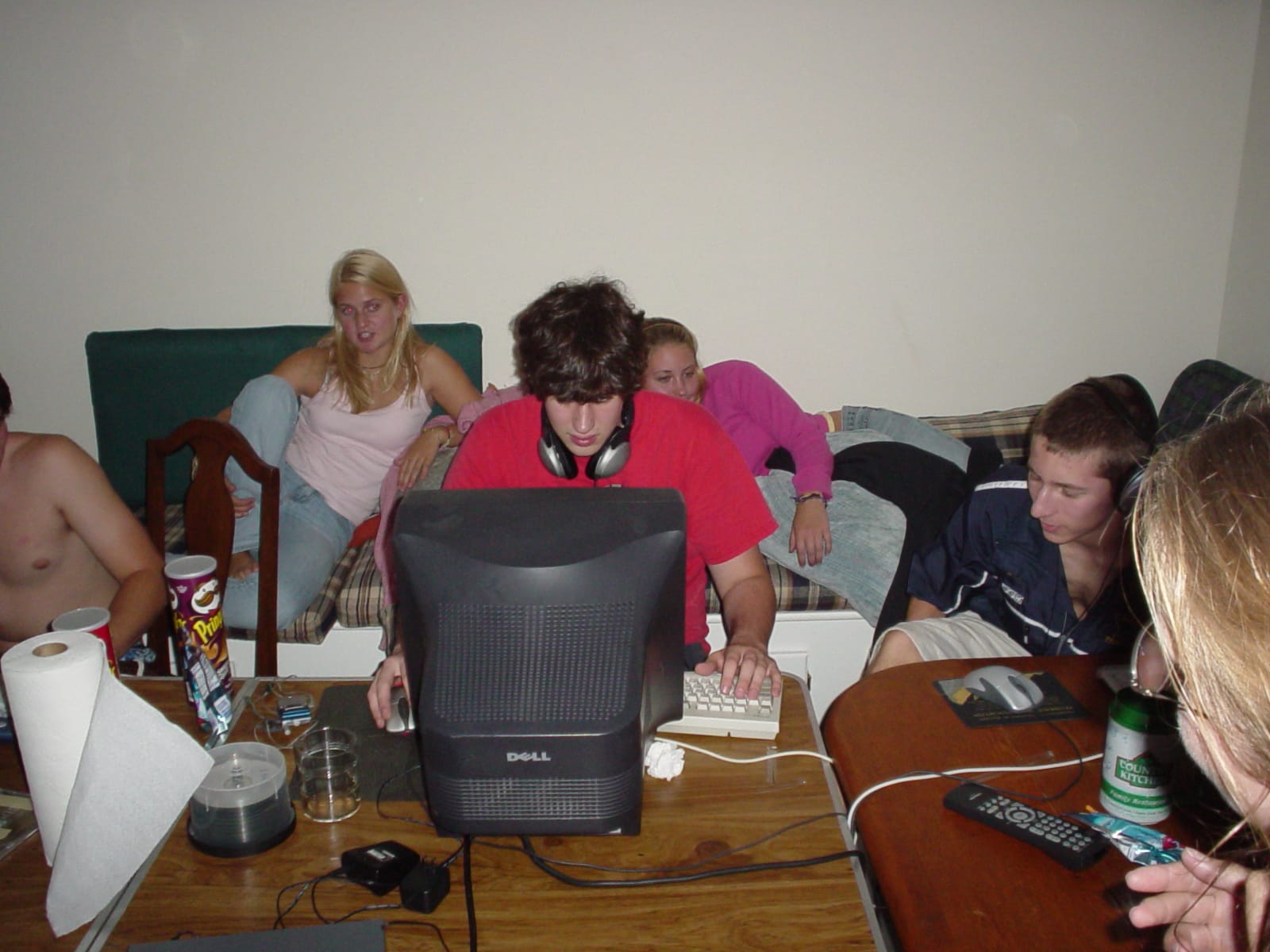
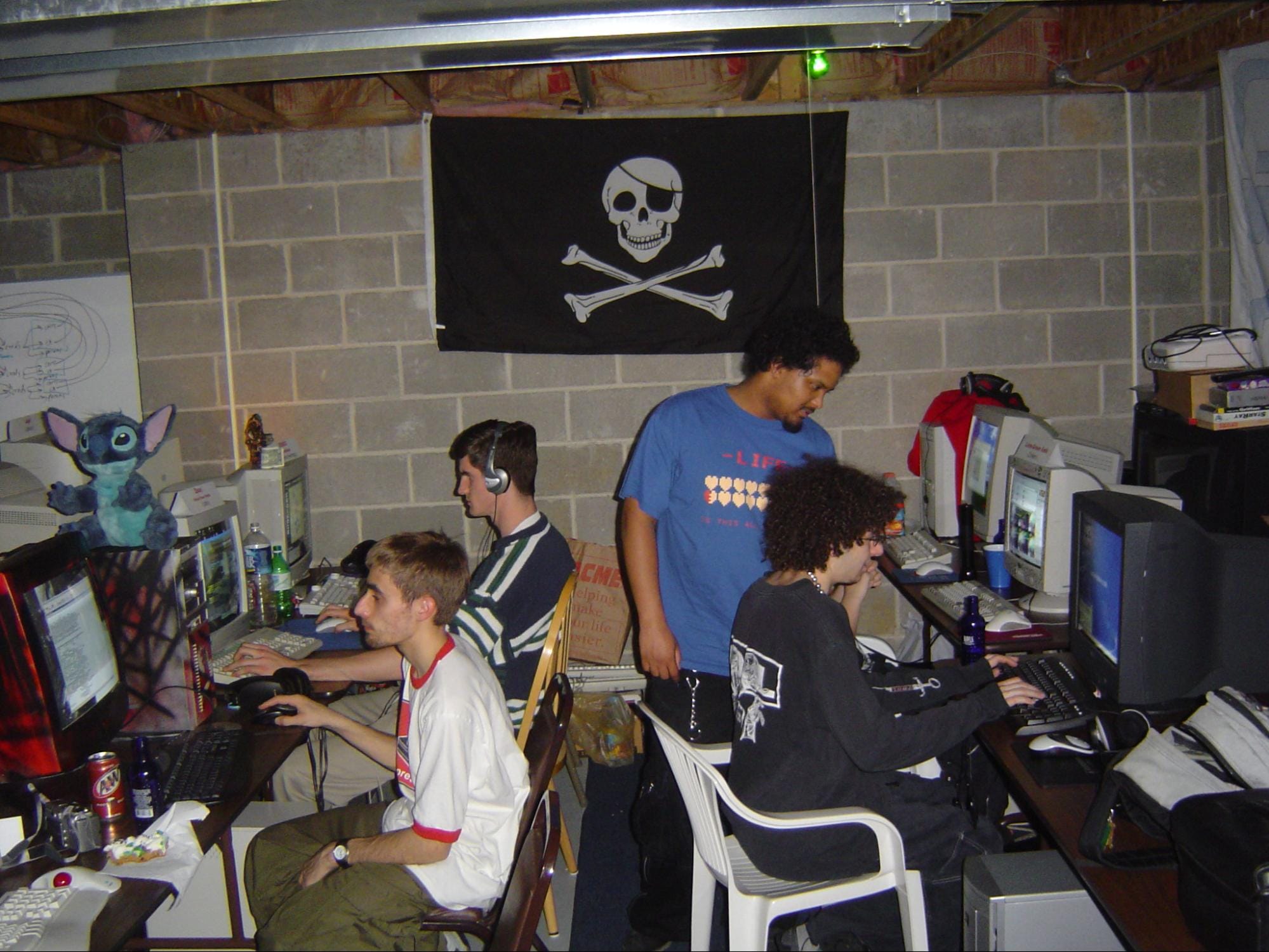
This ensured a relatively lag-free experience, but it also meant coming to grips with the physical reality of computing — hauling heavy CRT monitors and PC towers into place, connecting everything with network cables and switches. Things seldom went off without a hitch, and LAN events frequently involved a lot of troubleshooting, not to mention careful maneuvering to avoid tripping over a cord and bringing everything crashing to the ground, or spilling a two-liter bottle of soda across a keyboard.
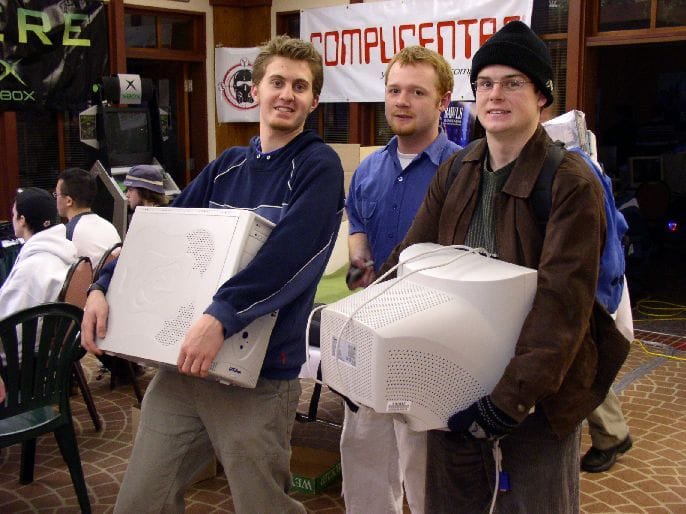
Aaron Kostiuk, 2003 (left) and Toby Cherasero, 2000 (right)
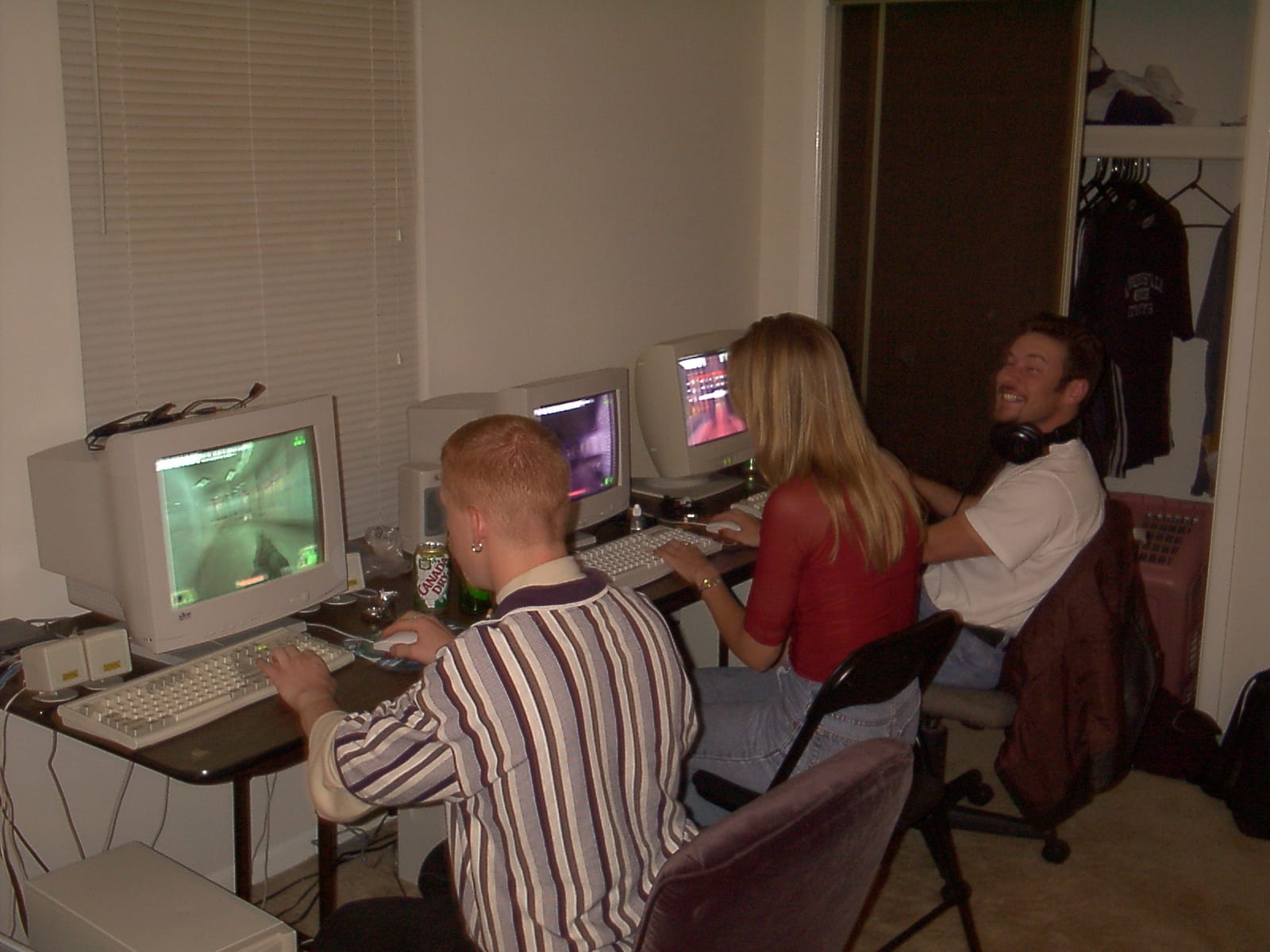
LAN parties were, obviously, eminently social events. People came together in a central location not just to play games, but to hang out, listen to music, and carry out early forms of file sharing — whether by burning CDs or directly transferring games, music, and movies across the local network. Anecdotally, they were attended and organized mainly by young white men, but the photos collected in my book LAN Party demonstrate that women and people of color were present at LAN parties going back to the 90s and 2000s.
Definitionally, a LAN party could be anything from a small, private event in someone's home to a massive multi-day affair in a hotel, gym, or expo hall. Like arcades had in the 1980s, they made gaming into a collective experience — an atmosphere. For many, they were formative spaces where they made social connections and forged bonds that would last for years to come. While competition could be fierce, especially at tournament-level events, there was always a limit to how aggressive or disruptive someone could be before those around them simply wouldn't put up with it anymore.
THE DEATH OF LAN AND THE RISE OF PLAY AS WORK
In compiling photos for LAN Party, I spoke with two groups of people who were effusive in their admiration of LAN events. The first was comprised of those who had attended LANs in their youth, who now looked back fondly on their memories. The second, more surprising group, was made up of younger people who, upon seeing the photos of disheveled gamers jamming out all-night Counterstrike sessions, would ruefully say something like "I was born in the wrong era."
If LAN parties appeal both to younger gamers and older ones, then why have they become so much less common over the last few decades? Probably the single most critical factor is the spread of high-speed internet connections and the convenience it offers. Once it became possible to play first-person shooters over a distance with minimal latency, the need to haul machines to a central location evaporated. On top of this, emerging services like Microsoft's Xbox Live, which launched alongside the landmark Halo 2, made it possible for friends to virtually queue together for games online. Matchmaking meant that you no longer needed to find a populated server or wait for all of your friends to be online to get a game going. Instead, players could form parties and communicate over voice chat, then allow the software to find games for them.
With matchmaking came the concept of ranking. While individual game servers had their own ranking systems previously, and tournament-level play had long existed, the notion of a persistent rank that a player carried with them was relatively novel. Halo 2 calculated a player's rank based on their performance and then used this to match them with other, comparable players. Nearly all online games now use some sort of matchmaking and ranking system, and many of them tie it to some form of rewards. Play well enough — or just enough generally — and you can unlock new weapons and cosmetic items.
Once play became tied to rewards, battle passes, and loot, it ceased to be for itself. In a way, it ceased to be play at all. It's the difference between playing Halo with friends with no expectation of "advancement," except perhaps in personal skill, and playing Halo Infinite and receiving a variable amount of "experience" after each match.
A major part of many online games is now "grinding," a term which comes from roleplaying games where players often have to spend time battling relatively easy monsters in order to level up and increase their statistics. In online games, players grind for rank and battle pass progress, and play comes to resemble a kind of work. While most players of these games would probably still describe them as fun in themselves, the consequences of each game are no longer circumscribed to the "magic circle" of play on a private server or at a LAN party with friends. Instead, victory or defeat determine a player's advancement in rank or towards desired items.
One of the side effects of the move away from LAN parties towards global competition on persistent servers is a shift towards the optimization and quantification of play. This shift has occurred in parallel to the quantification of social life that was brought on by the mass uptake of social media platforms in the 2010s. Players and users of these platforms generate data which they carry around with them — kill/death/assist statistics, follower counts, and so on. Playing a first person shooter is no longer just about having a fun time with your friends. Indeed, it would be nearly unthinkable for a multiplayer game to ship without some kind of battle pass or progression system today. And while players expect these features, they can rob games of their intrinsic enjoyment. Players describe themselves as working towards various rewards, and as a result play becomes more like, well, work.

Serafin Villar, 2005 (left) and Matthew Sweeney, 2003 (right)
LEARNING FROM LANS
Ironically, local-area gaming diminished in popularity precisely as it became easier than ever to do. Miniaturization resulted in the development of gaming laptops, and ad-hoc wifi eliminated the need for wired connections. Some handheld devices explored the possibilities of in-person multiplayer gaming throughout the 2000s and 2010s, most notably Nintendo's DS and 3DS consoles. There were early efforts to use the proliferation of smartphones for these purposes, too. Games like Spaceteam used the fact that everyone was now carrying their own interactive communicative device to great effect. But these sorts of experiences have become less common, and it doesn't help that many modern multiplayer games require a connection to a central server, making LAN play impossible.
Still, some people continue to hold LAN parties. For those who are too young to remember their glory days, they can be a fascinating alternative to the modern mode of play — hopping on Discord and partying up in an online game. For those who were there back in the day, they provide an excuse to get together with old friends.
At the same time, LAN parties and other forms of in-person multiplayer gaming have recently become a strange site of culture war for right-wing reactionaries. For instance, a Tim Pool tweet from 2024 reads "you guys were playing halo, split screen mutiplayer, ordered pizzas, laughed and chilled all night. you didnt even realize it would be the last time." Obviously, all of these things are still completely possible to do in the current year, and one reading of this post is simply a yearning for an earlier period in one's life when there were fewer obligations. But influencers like Pool actively cultivate the sense in their fans that these pleasant childhood experiences have been "taken" from them in some way.
As millennials age into middle adulthood, they have begun to retroactively construct an imagined utopia of the 90s. We may not have "drank from the hose," as the oft-repeated joke about Gen X'ers goes, but we apparently played outside all afternoon until the lights came on, hung out at the mall, and weren't glued to screens all the time. And while this kind of longing for and romanticizing of the conditions of one's youth may be inevitable for each generation, it's important to remember that many millennials were in fact excited about the technological shifts of the early 2000s. We enthusiastically adopted cell phones, social media, and online gaming. That those technologies might become tools of alienation down the line was not necessarily obvious to young people at the time.
Today, fascist ideology seizes on this nostalgia and promises to allow a return to a time before "politics" through the exclusion or purging of difference. Fascist leaders essentially take the place of parental figures, restoring their subjects to a pre-political childhood status. So it's hardly surprising that popular entertainment — video games, genre movies, and so on — are a key site of fascist grievance, since the childhoods of most Americans after Reagan deregulated advertising were overwhelmingly shaped by mass media and consumer products.
In gaming, this manifests as a desire to eliminate "woke" elements and "tourists" — mainly women, non-heterosexual people, and so on, in order to reclaim an idealized pure state before entertainment and enjoyment was compromised. But as the visual history of LAN parties demonstrates, such a time never truly existed.
That fascists cling to fantasies of an impossible return to the ignorance of childhood is not reason for those who find them abhorrent to reflexively reject the affection people have for LAN parties and other forms of in-person gaming as inevitably regressive. Ironically, LAN parties and similar forms of play may have even actually served as a protective force against the radicalization of otherwise-isolated young men. Playing and socializing with your friends is, after all, generally a positive experience. And many of the trends which have developed in the modern games industry are in fact destructive — not the ones which gesture towards greater inclusion, but those that inculcate addiction and transmute play from a joyful experience into a rote and compulsive one.
As American culture launches into yet another examination of the ways in which young men are suffering, some critics will inevitably lay the blame, as they have for decades now, on video games. These arguments might have more of a point post-2015, when Gamergate irreversibly transformed the ways in which the culture wars were waged and, some would argue, directly led to our current political moment. It's true that a number of gaming microcelebrities and streamers have championed right-wing messages, and that platforms like YouTube tend to algorithmically funnel viewers from gaming content into high-performing outrage bait about "woke" games.
But video games — like all games — are not inherently about domination and vicious competition. The most violent, hardcore first-person shooter can be played for laughs, just as a game of pickup soccer can be. And it's much easier to adopt this kind of social, playful attitude towards games in face-to-face contexts rather than over a fiber optic connection. LAN parties certainly aren't the cure for America's many economic and cultural ills, but in a period in which people feel atomized and alienated, finding ways to play games together more frequently seems more important than ever.
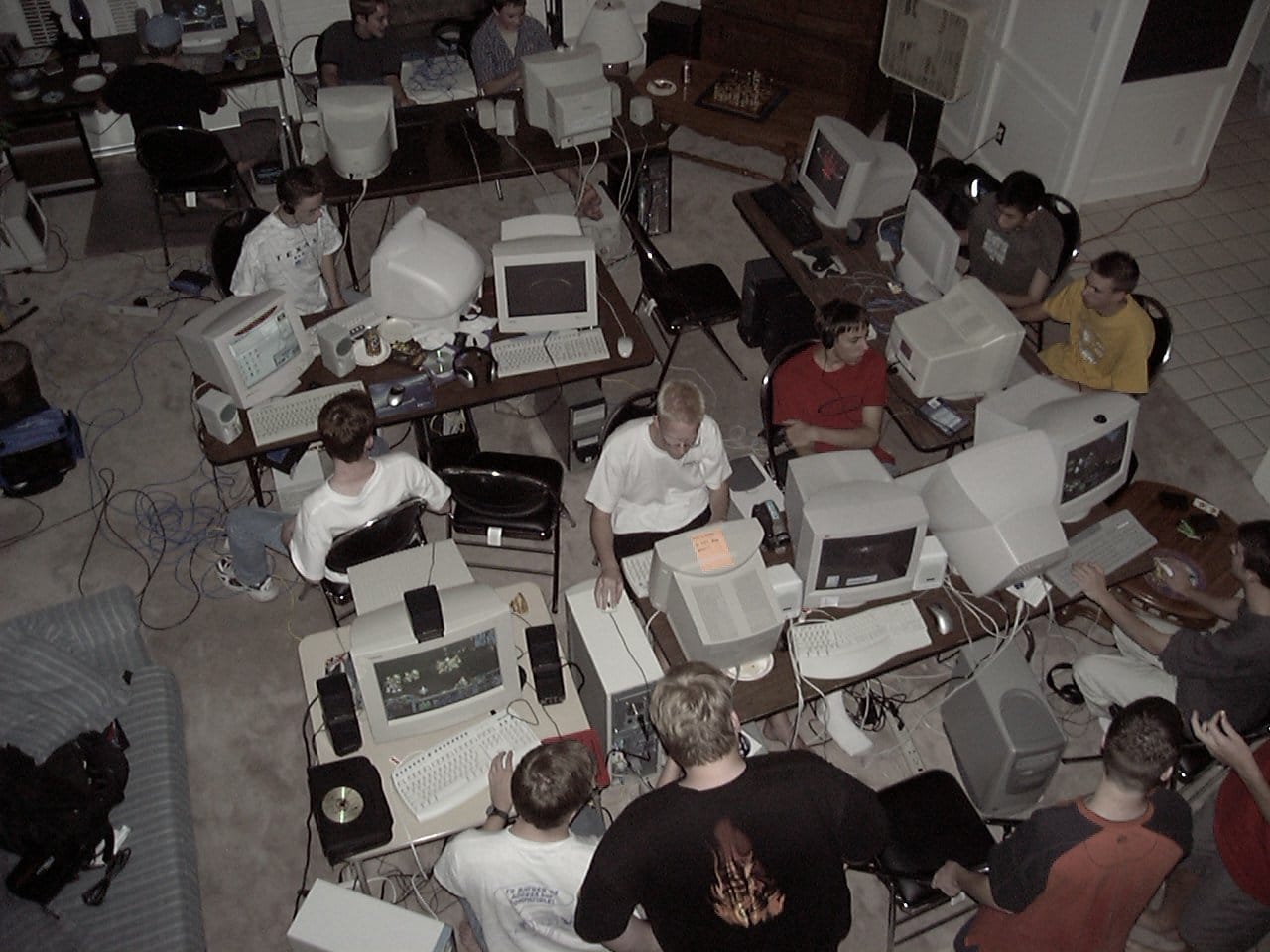
Want to see more? Check out LAN Party: Inside the Multiplayer Revolution for additional photos and commentary by Merritt K.